

In many Christian traditions, Good Friday is a day of fasting. The extent of the fast varies, but in our family we eat a small breakfast (usually hot cross buns) and then nothing until the evening, breaking our fast with soup and fresh bread (and more hot cross buns.) It is a day of quiet, and contemplation, and hunger– especially in the afternoon, as I struggle with my hunger-induced temper and try not to grumble. Dinner is always doubly appreciated on Good Friday.
Several years ago I found myself wondering if there were “traditional” Good Friday recipes, and after some searching I stumbled across this Lebanese dish. “Kibet el rahib,” or “Monk’s Soup,” is said to have been eaten by Jesus and Mary, though I haven’t been able to find any information on the history of this soup. Regardless, there’s something delightful in a recipe that old, and in such a physical, concrete connection to the past. As I wrote yesterday, food is a strong connector– and for me, preparing something that was prepared many centuries ago tugs on that cord that binds us to our history, and which is so often unnoticed in day-to-day living. The preparation of this soup has become a ritual for me, bringing me back 2000 years, connecting me to people and places that normally seem so impossiblly distant, even unreal. I am suddenly made aware that 2000 yeas ago people were much the same; they prepared dinner, they ate together and discussed the minutia of their days, they laughed at each other’s jokes, grumbled over annoyances, and delighted in the hugs of their small children. Their needs, loves, joys, and griefs were largely the same as ours are now, and there is so much less division than we imagine between our humanity and theirs.
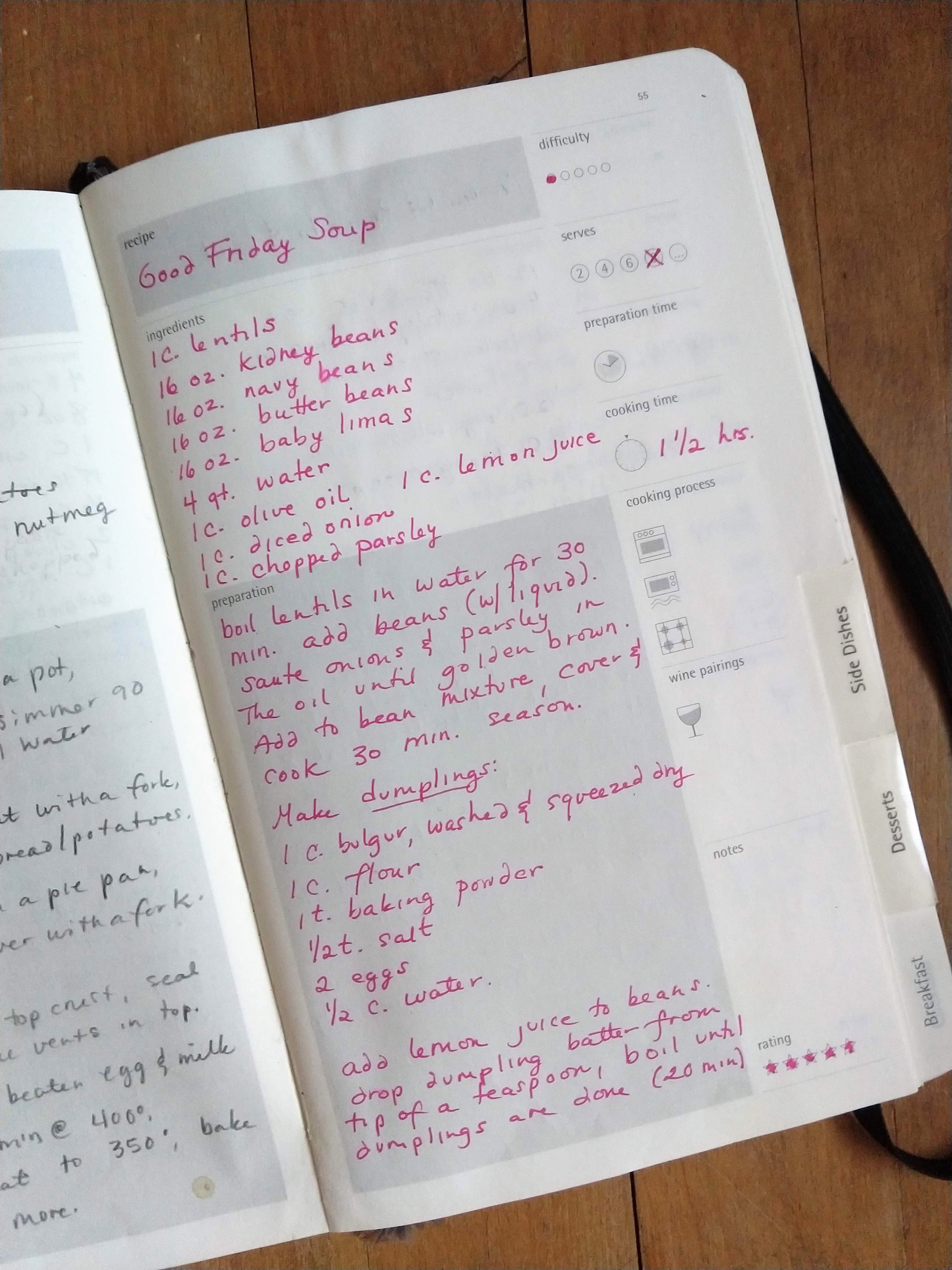
We only prepare Kibet el rahib once a year, and its rarity (and our hunger) elevate this simple soup into something quite special that we look forward to all year. Unfortunately, I no long know the source for this recipe. As with the Fassolada, make sure you do not skimp on the olive oil! The recipe makes a large amount of soup, so I often halve it. The extra beans from each can can be frozen for a future meal.
Good Friday Soup (Kibet el rahib)

- 1 c. lentils, washed and sorted
- 15 oz. can kidney beans
- 15 oz. can navy beans
- 15 oz. can butter beans
- 15 oz. can baby lima beans (or 1 3/4 cups frozen)
- 4 quarts water
- 1 c. olive oil
- 1 c. diced onion
- 1 c. chopped parsley
- 1 c. lemon juice
- salt & pepper
- 1 c. bulgur wheat
- 1 c. flour
- 1 teaspoon baking powder
- 1/2 teaspoon salt
- 2 eggs
- 1/2 c. water
- Add the 4 quarts water and the lentils to a large stock pot, and bring to a boil. Reduce heat and simmer for 30 minutes.
- While the lentils are cooking, heat the olive oil is a pan until shimmering. Add the onions and parsley and saute until the onions are golden brown. Remove from heat.
- When the lentils have cooked for 30 minutes, add the kidney, navy, butter, and lima beans, with their liquid. Add the onions mixture. Return to a simmer and cook, covered, for 30 minutes.
- While the soup simmers, make the dumpling batter:
- Rinse the bulgur wheat thoroughly, and squeeze dry (you can wrap it in a towel and squeeze, or put in a fine mesh sieve and press firmly.)
- Combine the bulgur with the flour, baking powder, salt, eggs, and water to make a thick dough.
- Once the lentils are tender, taste the soup and adjust the seasoning. Stir in the lemon juice.
- Now drop the dumpling batter from the tip of a teaspoon across the top of the soup. (Each bit of batter should be about the size of a marble, but will puff up when cooked.)
- Adjust the heat so the soup boils gently; cook until the dumpling are cooked through, about 20 minutes.
Hot Cross Buns

From The Joy of Cooking
Hot Cross Buns are something else we only make once a year, and look forward to eagerly! To enjoy them hot early in the morning on Good Friday, take them out of the oven a few minutes early when you bake them on Thursday. Do not ice; when they are cool, cover tightly. The next morning, heat the oven and bake them another 5-8 minutes, and then ice them as directed.
- 1 c. milk
- 2 Tablespoons butter, softened
- 1/4 c. sugar
- 3/4 teaspoon salt
- 1/4 c. currants or raisins
- 2 Tablespoons finely chopped candied citron
- 1/4 teaspoon ground cinnamon
- 1/8 teaspoon ground nutmeg
- 1 egg, beaten
- 2 Tablespoons warm water
- 2 1/4 teaspoons (1 packet) active dry yeast
- 3 1/2 to 3/12 cups all-purpose flour
- 1/2 cup confectioner’s sugar
- 2 teaspoons warm milk
- Warm 1 cup milk (between 105-115 degrees.) Add the butter, sugar, salt, spices, and fruit, and stir until the sugar dissolves.
- Combine the warm water and yeast in a small bowl, and let stand until the yeast is dissolved (about 5 minutes.) When the milk mixture is lukewarm, stir in the egg and the yeast mixture.
- Stir in 3 cups of the flour, then turn out the dough onto a floured work surface. Knead in the remainder of the flour, using only as much as necessary to create a soft dough that can be handled easily. Place the dough in a greased bowl, cover, and let rise until doubled in bulk.
- Punch the dough down, and shape into 18 equal-sized balls. Place them about 1 1/2 inches apart on a greased or lined baking sheet. Cover and let rise again until they are nearly doubled.
- Preheat the oven to 425 degrees. Bake the buns for 20 minutes, until golden brown. When they have cooled, decorate them with the traditional cross, using a glaze made with 21/2 cup confectioner’s sugar and 2 teaspoons hot milk.
 In Due Season